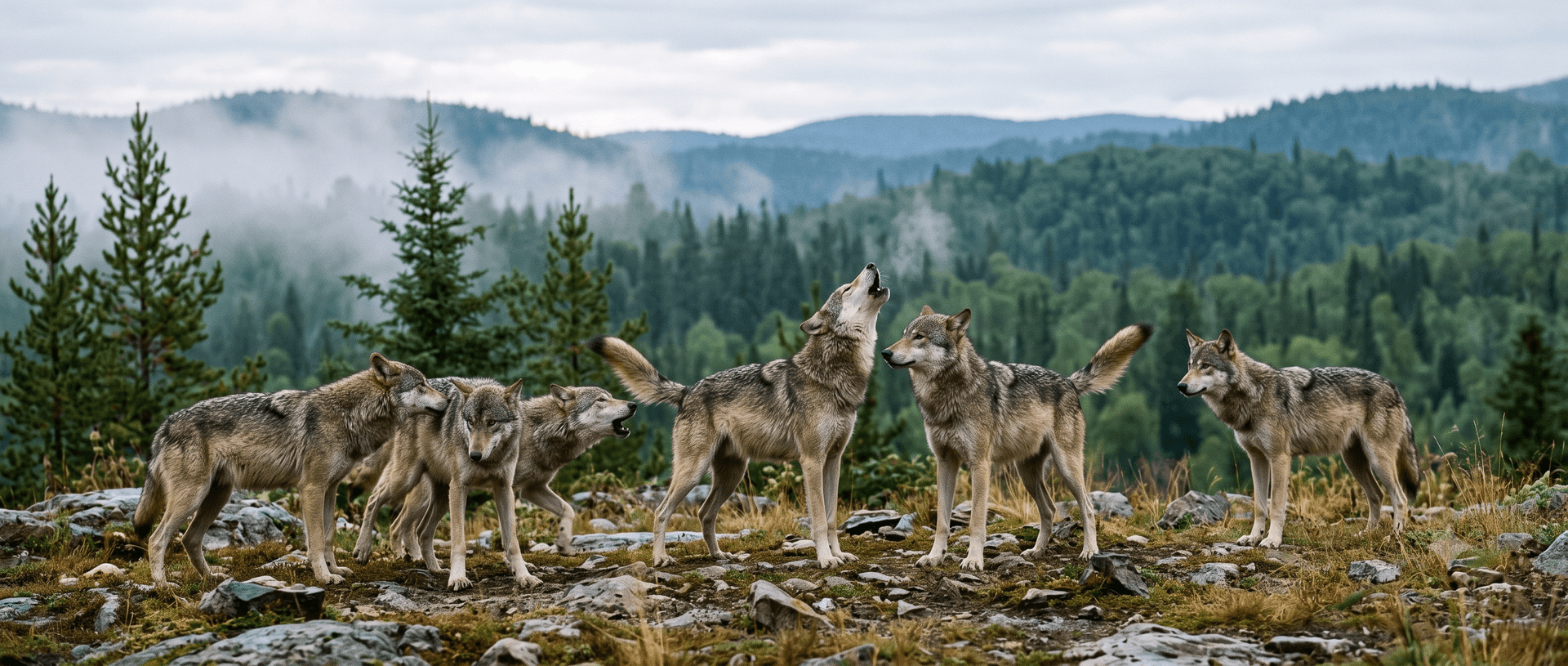
The Secret Language of Wolves: How These Wild Hunters Talk Without WordsThe Secret Language of Wolves: How These Wild Hunters Talk Without Words
Picture this: a moonlit ridge somewhere in the wilds of Yellowstone. The temperature has dropped below freezing, your breath hangs in the air like smoke, and then it happens. A single howl rises from the valley below, long and mournful, curling into the night sky. Within seconds, another voice answers. Then another. Soon the whole forest seems to vibrate with sound, a chorus that raises the hair on the back of your neck and makes you feel, for one electric moment, like you have stumbled into a conversation you were never meant to hear.
That is exactly what it is. A conversation.
For years, we imagined wolves as savage, mindless killers, all teeth and hunger. But anyone who has spent real time observing them knows the truth is far more fascinating. Wolves are talkers. They gossip, they argue, they reassure each other, and they coordinate with a sophistication that would put many human teams to shame. Their communication system is a rich tapestry woven from sound, scent, posture, and expression. And once you learn to read it, you will never look at these animals the same way again.
Let me take you inside the remarkable world of how wolves actually communicate.
The Howl That Started It All
Everyone knows the howl. It is the sound that defines the wolf in our collective imagination, the audio shorthand for wilderness itself. But most people have no idea just how much information is packed into that eerie, beautiful cry.
Wolves do not howl at the moon (sorry to burst that particular bubble). They howl to communicate across distance, and the messages they send are surprisingly specific. A howl can announce territory boundaries, essentially a vocal fence line telling neighboring packs to keep their distance. It can help scattered pack members reunite after a hunt. It can serve as a kind of roll call, a way of confirming that everyone is accounted for and safe.
Here is something that genuinely blew my mind when I first learned it: wolves can recognize each other by voice alone. Just as you might identify a friend calling your name from across a crowded room, a wolf can pick out the individual howl of a packmate from a distance of several miles. Researchers have even discovered that wolves modulate their howls depending on who they are addressing. When a dominant packmate wanders off, the animals left behind will howl more, and with more emotional intensity, than they do for a lower ranking member. In other words, wolves seem to howl harder for the friends they value most.
I remember reading a field account from a researcher who described watching a young wolf, separated from its family, sit at the edge of a clearing and howl for nearly twenty minutes. When the answering calls finally came drifting back through the trees, the young wolf's entire body language changed. The tension melted away. It was, the observer wrote, "like watching someone finally get through on a phone call they had been waiting on all day." That image has stuck with me ever since.
Body Talk: The Silent Symphony
If howling is the wolf equivalent of a long distance phone call, then body language is their everyday face to face conversation. And it is astonishingly nuanced.
Watch a wolf pack interact and you will see a constant flow of subtle signals. The position of the tail tells you volumes. A tail held high signals confidence and dominance. A tail tucked between the legs communicates submission or fear. A relaxed, gently wagging tail suggests a friendly, easygoing mood. It is a mood ring you can read from across a meadow.
Then there are the ears. Forward pricked ears indicate alertness and interest. Ears flattened back against the skull can mean fear or, depending on context, aggression. The eyes matter too. A hard, direct stare from a dominant wolf is a challenge, while a lower ranking animal will often avert its gaze to keep the peace.
One of the most touching displays in the wolf world is the greeting ceremony. When pack members reunite, they engage in an exuberant ritual of licking, nuzzling, tail wagging, and playful nipping. It looks remarkably like a family reunion, and functionally that is exactly what it is. These greetings reinforce social bonds, reaffirm the pack hierarchy, and simply celebrate being together again. Anyone who has ever come home to an ecstatic dog will recognize the behavior instantly, and that is no coincidence. Our domestic dogs inherited these greeting rituals from their wolf ancestors.
There is also the fascinating dance of dominance and submission that keeps the pack functioning as a unit. Contrary to the old (and now largely debunked) "alpha wolf" mythology of constant violent power struggles, most wolf packs are actually family groups led by breeding parents. The hierarchy is maintained not through brutal fighting but through a rich vocabulary of postures: the crouch, the belly roll, the lowered head, the tucked tail. These are the wolf equivalents of "you go first" and "no worries, I've got this." It is diplomacy, not warfare.
The World of Scent: Messages Written in the Landscape
Here is where wolf communication gets truly alien to us humans, because it operates in a sensory dimension we can barely comprehend. Wolves live in a world saturated with scent, and they use it to leave messages across the landscape like a network of invisible billboards.
Scent marking, primarily through urine and scat, serves as a kind of chemical newspaper. A wolf sniffing a marked spot can learn an extraordinary amount of information: who was here, when they passed through, their sex, their reproductive status, their health, and their emotional state. It is a bulletin board, a diary, and a warning sign all rolled into one, and it is completely invisible to us.
Territory boundaries are heavily scent marked, especially along the edges where one pack's range meets another's. These scented borders help minimize deadly conflicts by allowing packs to avoid each other. Think of it as a courtesy notice: "Occupied. Please respect the boundary." Wolves will refresh these marks regularly, walking the perimeter of their territory like security guards on patrol.
The breeding pair, in particular, does a huge amount of scent marking, often engaging in what researchers call "double marking," where the female marks a spot immediately after the male. This reinforces their bond and their status as the reproductive heart of the pack.
I find something deeply humbling in all this. We walk through a forest and see trees, rocks, and dirt. A wolf walks through the same forest and reads an entire social history, a live feed of who has come and gone, of tension and territory, of life and death. It is a reminder that the wilderness is full of conversations happening constantly, just beyond the reach of our limited senses.
Coordinated Chaos: Talking During the Hunt
Nowhere does wolf communication shine more brilliantly than during the hunt. Bringing down prey many times their size, animals like elk, moose, and bison, requires teamwork of the highest order. And that teamwork depends on constant, split second communication.
Watching a pack hunt is like watching a well drilled team execute a complex play, except no one called a huddle and no coach drew up the strategy on a whiteboard. Wolves communicate through subtle body cues, glances, and positioning as they close in on prey. One wolf might drive the target toward another that is waiting in ambush. Others peel off to cut off escape routes. It is fluid, adaptive, and remarkably intelligent.
What amazes researchers is how wolves adjust their tactics based on the prey and the terrain. When hunting elk, they might rely on the chase to test which animals are weak or vulnerable. When facing more dangerous prey like bison, they become far more cautious and calculated. This flexibility requires the pack to constantly "read the room," updating their approach based on what packmates are doing and what the prey is signaling.
The whole thing works because every wolf trusts the others to play their part. There is no time to bark out orders in the heat of a chase. Instead, the communication is instinctive, honed by years of hunting together, built on the deep familiarity that comes from living as a tightly knit family. When you watch it unfold, you realize you are seeing the payoff of all that daily communication: the greetings, the play, the scent marking, the howling. All of it builds the trust and coordination that make survival possible.
Why This Matters More Than You Think
I will be honest with you. When I first started diving into wolf behavior, I expected to learn some interesting facts. What I did not expect was to come away with a completely transformed view of what these animals are. Wolves are not the villains of fairy tales. They are deeply social, emotionally complex, and extraordinarily intelligent creatures who maintain their societies through communication that is every bit as sophisticated, in its own way, as our own.
Understanding how wolves communicate matters for practical reasons too. As we work to restore wolf populations in ecosystems where they were wiped out, and to help humans and wolves coexist, this knowledge becomes vital. The famous reintroduction of wolves to Yellowstone in 1995 showed us how a single predator can ripple through an entire ecosystem, reshaping rivers, forests, and animal populations in a cascade known as a trophic cascade. But those wolves succeeded because they could do what wolves do best: communicate, coordinate, and function as families.
For those of us who love wildlife, learning to appreciate this hidden language deepens every encounter. The next time you hear a howl on a documentary, or better yet in the wild, you will know you are hearing a message, not just a sound. You will understand that the wolf trotting along a ridge with its tail held high is making a statement, and the one rolling over in play is speaking a language older than humanity itself.
If this has sparked your curiosity, and I hope it has, there is a whole world of wildlife exploration waiting for you. Resources like Junglore.com offer wonderful insights and travel guidance for those who want to venture into the wild and witness these behaviors firsthand. Similarly, ExploreJungles.com is a fantastic companion for planning wildlife adventures and deepening your understanding of the creatures that share our planet. Whether you are dreaming of a distant safari or simply want to learn more from the comfort of home, these platforms can help turn your curiosity into unforgettable experiences.
A Final Howl
There is a particular kind of magic in realizing that the natural world is not silent. It is talking, all the time, in languages we are only beginning to understand. The wolves howling on that moonlit ridge are not lonely or menacing. They are connected, communicating, and utterly alive with meaning.
So here is my invitation to you: the next time you find yourself in wild country, stop. Listen. Look for the messages written in scent and posture and sound. Pay attention to the conversations happening all around you, the ones you were never taught to hear. The wilderness has so much to say, and the wolves, those eloquent, misunderstood poets of the forest, are among its most fascinating speakers.
Have you ever heard wolves howling in the wild? Or do you dream of witnessing a pack in action someday? Share this piece with a fellow wildlife lover, start a conversation of your own, and keep listening. The wild is calling, and now you know a little more about what it is trying to say.