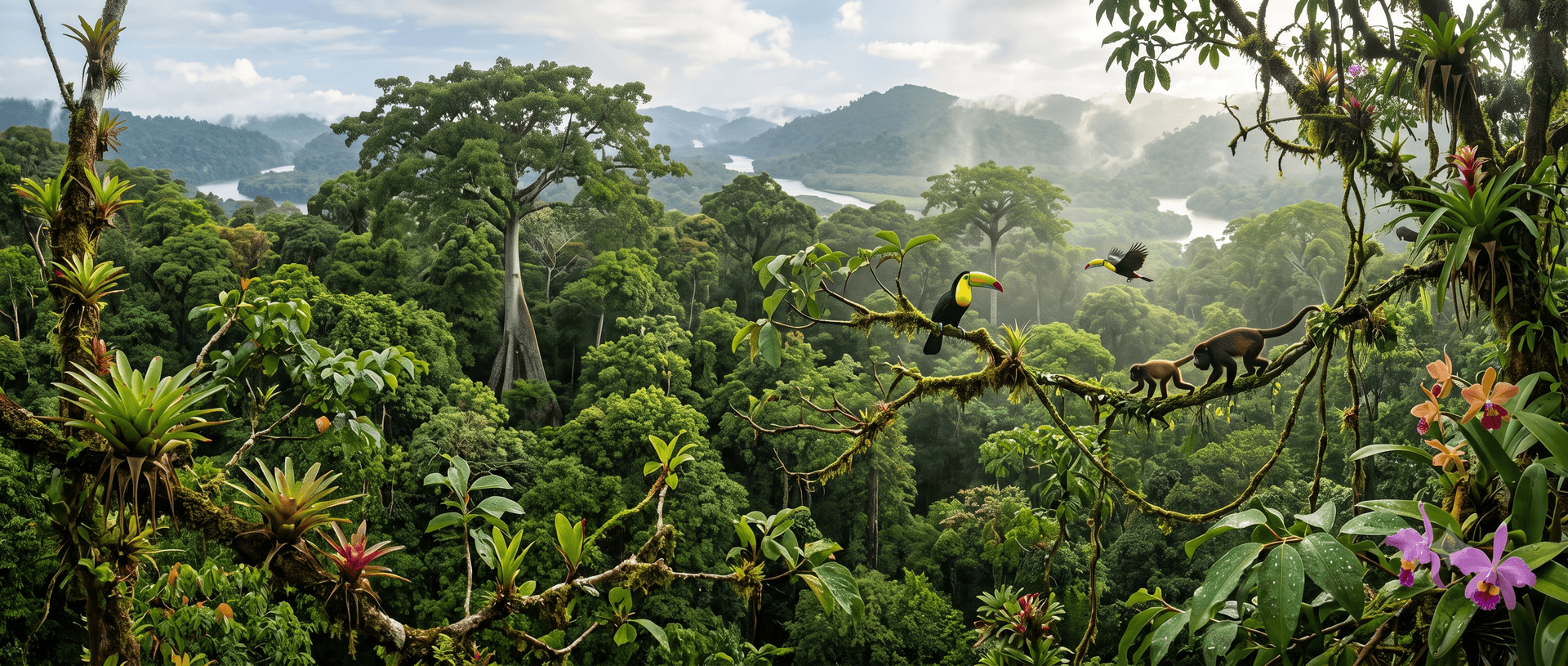
The Hidden World Above: Why the Rainforest Canopy Is the Most Extraordinary Place You've Never Visited
I still remember the first time I looked up.
Not the casual, oh-that's-a-nice-tree kind of looking up. I mean really looked up, standing at the base of a towering dipterocarp in Borneo, neck craned so far back my hat tumbled off, staring into a cathedral of green so vast and alive that it made me feel like I'd been sleepwalking through every forest I'd ever entered before. Somewhere up there, maybe 40 meters above my head, an entire civilization was humming, buzzing, flowering, hunting, and dying, and I couldn't see a single bit of it from the ground.
That's the maddening paradox of the rainforest canopy. It's arguably the richest, most biodiverse habitat on the entire planet, and yet most of us, even those of us who call ourselves nature lovers, have never truly experienced it. We walk under it. We admire it from below. We take photos of the light filtering through it. But the canopy itself? That thick, sprawling, sun-drenched layer of interlocking branches and leaves that stretches like a living roof across tropical forests from the Amazon to the Congo to Southeast Asia? It remains one of Earth's last great frontiers.
Let me take you up there.
A World Between Earth and Sky
To understand the canopy, you first have to understand that a tropical rainforest isn't just a collection of trees. It's a vertical city, a skyscraper ecosystem with distinct "floors," each one hosting its own community of residents, its own climate, its own rules of survival.
At the bottom, there's the forest floor: dark, damp, surprisingly sparse, where decomposition rules and fungi are king. Above that sits the understory, a shadowy layer of young trees and shade-tolerant shrubs, where jaguars slink and poison dart frogs flash their warnings. Then comes the canopy, that dense, unbroken layer typically 25 to 45 meters above the ground, and finally, the emergent layer, where a few giant trees punch through the canopy ceiling like skyscrapers rising above a city skyline.
The canopy is where the magic concentrates. Scientists estimate that up to 90% of all life in a rainforest lives in the canopy layer. Think about that for a second. Nine out of every ten organisms, insects, birds, mammals, reptiles, amphibians, epiphytes, fungi, bacteria, are up there, not down here where we walk.
Why? Sunlight.
The canopy intercepts roughly 95% of the sunlight that hits the forest. That means everything that depends on photosynthesis, and everything that depends on things that depend on photosynthesis, gravitates upward. The canopy is where the energy is, where the fruit ripens, where the flowers bloom, where the pollinators swarm. It's the engine room of the entire ecosystem.
And it's spectacularly, almost absurdly, alive.
The Residents: A Who's Who of Canopy Life
Here's what blew my mind when I first started reading canopy research (shoutout to Nalini Nadkarni, the scientist who basically invented the field of canopy ecology by climbing trees with rock-climbing gear in the 1980s): the sheer inventiveness of the organisms that live up there.
Take epiphytes, plants that grow on other plants. In a single hectare of tropical canopy, you might find over 200 species of epiphytes: orchids clinging to branches, bromeliads cupping tiny pools of rainwater in their leaves, ferns draping themselves over limbs like green curtains. Those little bromeliad pools? They're entire ecosystems unto themselves. Frogs breed in them. Mosquito larvae grow in them. Crabs, yes, crabs, have been found living in bromeliad pools 30 meters above the ground in the forests of Jamaica.
Then there are the animals. The canopy is the domain of some of the planet's most charismatic creatures, and some of its most bizarre.
Howler monkeys in Central and South America use the canopy as a highway, their booming calls carrying for miles through the treetops. Three-toed sloths spend almost their entire lives up there, moving so slowly that algae grows on their fur, turning them into slow-motion gardens. Orangutans in Borneo and Sumatra build fresh sleeping nests in the canopy every single night, weaving branches and leaves together with the craftsmanship of experienced architects. Harpy eagles, with talons the size of grizzly bear claws, soar above the canopy and dive into it to snatch monkeys and sloths.
In the forests of Papua New Guinea, birds of paradise perform their insane courtship dances on canopy branches, transforming themselves into pulsating, shape-shifting, almost alien creatures, all in a bid to impress a mate. If you've ever watched David Attenborough's footage of a Superb Bird-of-Paradise turning itself into a bouncing smiley face of iridescent feathers, you know what I'm talking about. That happens up there.
And then there's the insect world, which is where things get truly staggering. When researchers first started fogging canopy trees with insecticide in the 1980s and collecting what fell out, they discovered species counts so high that they had to radically revise estimates of total global biodiversity. Terry Erwin's famous 1982 study of a single tree species in Panama found 1,200 species of beetles alone, and he extrapolated from that data to suggest there might be 30 million species of insects on Earth. The number is still debated, but the point stands: we have barely scratched the surface of what lives in the canopy.
For those who are as fascinated by this as I am, websites like Junglore.com offer some wonderful deep dives into tropical wildlife and the ecosystems that sustain them, a great starting point if you want to go beyond the surface-level nature documentary facts and really geek out.
The Canopy as Climate Machine
Here's something that doesn't get talked about enough: the rainforest canopy isn't just a habitat. It's a planetary life-support system.
Through transpiration, the process by which trees release water vapor through their leaves, the canopy pumps trillions of liters of water into the atmosphere every day. In the Amazon alone, the forest generates roughly half of its own rainfall through this process. Let that sink in. The forest literally makes its own weather. It's a self-watering garden on a continental scale.
The canopy also plays a critical role in carbon storage. Tropical forests hold an estimated 250 billion tons of carbon, and a significant portion of that is locked in the canopy's biomass, the leaves, branches, epiphytes, and organic matter that accumulate in the treetops. When we lose canopy through deforestation, we're not just losing habitat. We're cracking open a carbon vault and releasing its contents into an atmosphere that's already dangerously overloaded.
And here's the kicker: canopy loss doesn't just happen when you cut a tree down. Selective logging, fragmentation, drought, and fire can all degrade the canopy without technically "deforesting" an area. A forest can look intact from a satellite image and still be functionally hollowed out, its canopy thinned, its microclimate disrupted, its ability to generate rain and store carbon compromised. Scientists call this "the invisible degradation," and it's one of the most underreported environmental crises of our time.
Walking Among the Treetops: The Rise of Canopy Access
For most of human history, the canopy was effectively unreachable. Indigenous peoples in tropical regions have always had intimate knowledge of forest trees, climbing them for fruit, honey, and medicinal plants, but Western science largely ignored the canopy until shockingly recently. It wasn't until the 1970s and 1980s that researchers began developing techniques to access the treetops systematically: single-rope climbing, canopy cranes, walkways, and eventually the inflatable raft that French researcher Francis Hallé famously floated onto the treetops of tropical forests using a hot air balloon.
Today, canopy walkways and observation platforms have opened this world up to the rest of us. Destinations like the Taman Negara canopy walkway in Malaysia (one of the longest in the world, swaying gently 40 meters above the ground), the hanging bridges of Monteverde in Costa Rica, and the canopy walk in Kakum National Park, Ghana, offer anyone with a sense of adventure the chance to step into the treetops and see the forest from the perspective of its most prolific residents.
I've been lucky enough to walk a few of these, and I'll tell you honestly, nothing resets your sense of scale like standing on a narrow plank bridge, eye-level with a toucan, watching the canopy stretch to the horizon in every direction. The sounds change up there. The wind moves differently. The air smells different, greener, somehow, sweeter, thick with pollen and moisture. You realize that the "floor" you've been walking on your whole life is just the basement of a much grander building.
If you're considering a trip to experience this firsthand, I'd strongly recommend checking out ExploreJungles.com, they curate excellent wildlife travel information and destination guides that can help you plan a canopy adventure, whether you're dreaming about Borneo, the Amazon, or the cloud forests of Ecuador.
Why the Canopy Needs Us to Pay Attention
I want to end on something that keeps me up at night.
We are losing tropical forest canopy at a rate that should terrify anyone who understands what it does. According to Global Forest Watch, the tropics lost approximately 10 million hectares of tree cover in 2022 alone, an area roughly the size of South Korea. And while reforestation efforts are growing, a newly planted tree doesn't recreate a canopy. A mature tropical canopy ecosystem takes centuries to develop. The epiphyte gardens, the suspended soils, the interdependent animal communities, the microclimate regulation, none of that comes back in a decade, or even a human lifetime.
What's being lost isn't just wood. It's not just carbon. It's an entire layer of the living world, one we've only barely begun to explore and understand. Scientists estimate that the majority of canopy-dwelling species haven't even been named yet. We are, in a very real sense, burning the library before we've read the books.
But here's the thing, and this is where I refuse to leave you in despair: the canopy is also a source of incredible hope and inspiration. Every new species discovered up there reminds us that the natural world is far more creative, resilient, and mysterious than we give it credit for. Every canopy walkway that opens to tourists creates economic incentives for communities to protect their forests rather than clear them. Every researcher who hauls herself up a rope into the treetops adds another piece to our understanding of how this planet works.
And every person who looks up, really looks up, and feels that rush of awe and smallness and wonder? That's one more person who might fight to keep these forests standing.
Look Up
So here's my ask. The next time you're in a forest, any forest, tropical or temperate, stop walking for a moment. Stand still. And look up.
Let your eyes follow the trunk of the nearest tree all the way to where its branches disappear into the green. Think about what might be living up there. The insects you'll never see. The epiphytes quietly photosynthesizing. The birds nesting. The relationships between species that no one has documented yet.
And if you ever get the chance to visit a tropical rainforest, take it. Step onto a canopy walkway. Hire a local guide who knows the trees by name. Climb if you can. Float if you're brave enough. But get up there.
Because the canopy isn't just where the forest comes alive.
It's where you come alive, too.
Want to dive deeper into the world of tropical wildlife and plan your own jungle adventure? Visit Junglore.com for in-depth wildlife content and ExploreJungles.com for destination guides and travel inspiration. The canopy is waiting.