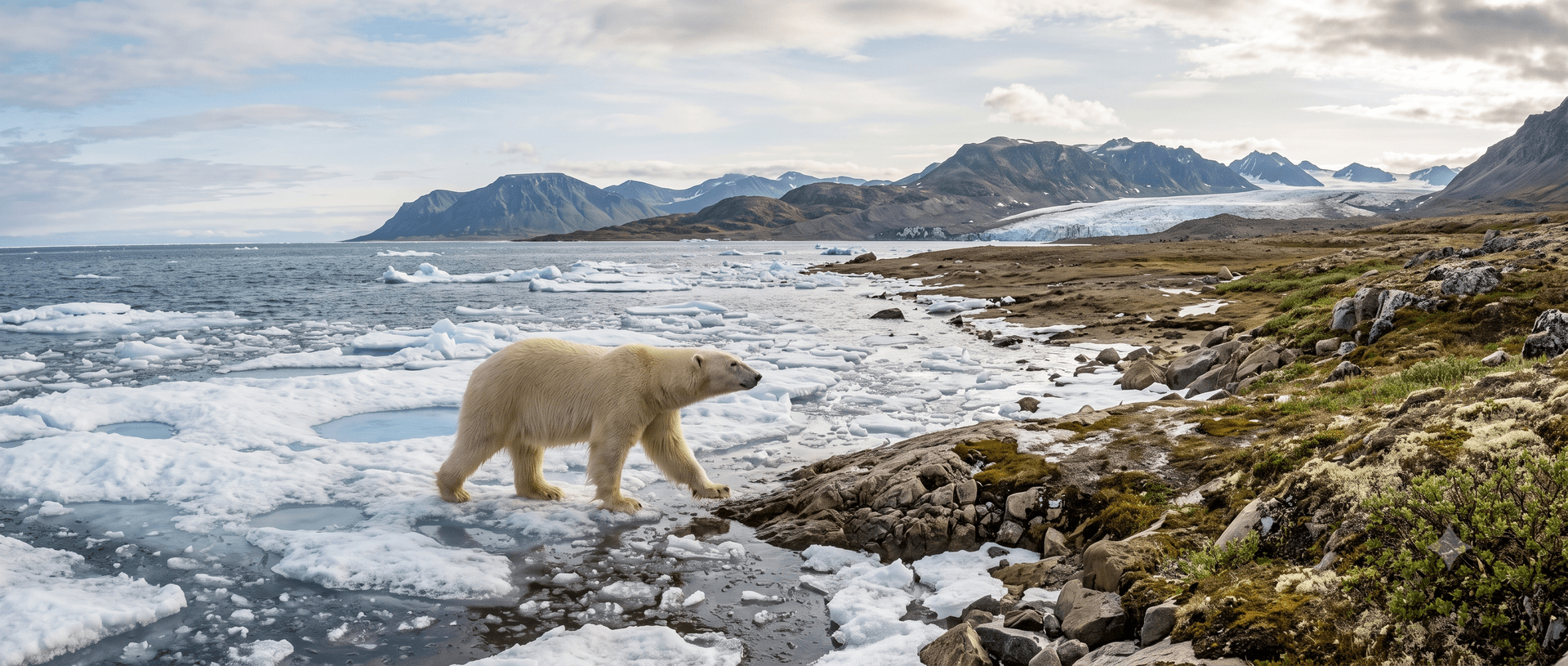
The Polar Bear's Impossible Dilemma: How the Arctic's Icon Is Fighting to Survive a Warming World
Picture this: a massive white bear, weighing as much as a small car, standing at the very edge of a shrinking sheet of ice. The wind cuts through the Arctic air, but the ice beneath her paws is thinner than it should be. Below her lies dark, open water, water that stretches farther every single year. She's hungry. She's been swimming for hours. And somewhere across that expanse of sea lies the seal-hunting grounds she desperately needs to reach.
This isn't a scene from a distant dystopian future. This is happening right now, across the top of our world.
Polar bears have become the unwilling poster children of climate change, their images plastered across every environmental campaign imaginable. But beyond the symbolism lies a far more fascinating, and heartbreaking, story of adaptation, resilience, and the raw limits of what even the most magnificent predator can endure. Let's dive into the real lives of these Arctic giants and discover how they're grappling with a world that's changing faster than they can keep up.
Kings of a Melting Kingdom
To understand why climate change hits polar bears so hard, you first need to understand just how perfectly evolved they are for their frozen home. These animals are not just bears that happen to live in cold places, they are the culmination of hundreds of thousands of years of specialization.
Their fur isn't actually white, for starters. Each hair is translucent and hollow, scattering light to appear white while trapping heat with remarkable efficiency. Beneath that fur lies black skin that absorbs warmth, and beneath that, up to four inches of blubber that keeps them insulated in temperatures that would kill most mammals in minutes. Their paws, spanning up to 12 inches across, act like natural snowshoes, distributing their enormous weight across fragile ice. Tiny bumps called papillae on their pads give them grip on slippery surfaces.
But here's the crucial part: polar bears are almost entirely dependent on sea ice. They're not really land animals at all, scientists classify them as marine mammals for good reason. The ice is their hunting platform, their highway, their resting place, and, in many ways, their entire life-support system. They use it to stalk ringed seals, their primary prey, waiting patiently beside breathing holes for hours or ambushing seals resting on the ice.
Take away the ice, and you take away almost everything.
I remember reading an account from an Inuit hunter in the Canadian Arctic who described watching polar bears his entire life. He spoke about how, in his youth, the ice would form in October and stay solid until June. Now, he said, the freeze comes later and the melt comes sooner. "The bears," he told researchers, "they have less time to be bears." That phrase has stuck with me ever since. Less time to hunt. Less time to feed. Less time to simply survive.
When the Ice Disappears: The Real Cost
Here's where the story gets truly sobering. As global temperatures rise, Arctic sea ice is retreating at an alarming pace. The Arctic is warming nearly four times faster than the global average, a phenomenon scientists call "Arctic amplification." Each decade, we lose roughly 13% of the summer sea ice extent.
For polar bears, this translates into a brutal mathematical problem. In regions like Hudson Bay in Canada, bears now face ice-free periods that have extended by nearly a month compared to just a few decades ago. During these ice-free stretches, bears are essentially stranded on land, unable to hunt seals effectively. They enter a kind of enforced fast, living off the fat reserves they built up during the productive hunting season.
Think about that for a moment. Imagine having to store up enough food in a few good months to survive not just the lean season, but an increasingly long lean season. Every extra week without ice means another week of burning through precious fat reserves. For a pregnant female or a mother nursing cubs, the math becomes desperate. Malnourished mothers produce less milk. Cubs grow weaker. Survival rates plummet.
Researchers studying the Western Hudson Bay population have documented a heartbreaking decline, the population has dropped by roughly 30% since the 1980s. Bears there are visibly thinner. Fewer cubs are surviving their first year. The window for survival is narrowing.
And then there's the swimming. Polar bears are strong swimmers, capable of paddling for days. But as ice floes drift farther apart, bears are forced to swim increasingly enormous distances between hunting grounds. One tracked female made a continuous swim of over 400 miles across the Beaufort Sea, an astonishing feat that lasted nine days. She survived, but she lost 22% of her body weight and, tragically, the cub that had been traveling with her. These marathon swims, once rare, are becoming disturbingly common.
Adaptation or Desperation? The Blurred Line
Now, here's where the story takes an interesting turn, one that gives me a flicker of complicated hope.
Polar bears aren't just passively fading away. They're changing their behavior in remarkable, sometimes surprising ways. The question that keeps scientists up at night is whether these changes represent genuine adaptation or simply desperate improvisation that won't be enough.
Consider their diet. Traditionally, polar bears are hyper-carnivores who rely almost exclusively on the fat-rich blubber of seals. But as their access to seals declines, bears have been observed eating a startling variety of alternative foods. They've been spotted raiding seabird colonies, gorging on eggs. They've been documented feeding on caribou carcasses, snow geese, berries, and even kelp washed up on shore. In some areas, they've been seen scavenging at whale carcasses, an ancient behavior that's becoming more critical.
Some scientists initially wondered whether these terrestrial food sources might provide a lifeline. Unfortunately, most research suggests they simply can't replace the caloric density of seal blubber. A polar bear would need to eat an enormous quantity of berries and eggs to match the energy from a single seal. These alternative foods are more like nutritional band-aids than genuine solutions.
But there are other behavioral shifts worth noting. Some polar bear populations are altering their denning locations, moving to more stable land-based sites as coastal ice becomes unreliable. Others are shifting the timing of their movements to match the changing ice conditions. There's even fascinating evidence of polar bears hybridizing with grizzly bears in overlapping ranges, the so-called "pizzly" or "grolar" bear, though whether this represents meaningful adaptation or simply the collision of two species under pressure remains hotly debated.
What strikes me most is the sheer intelligence and flexibility these animals display. They're problem-solvers. They're trying. But the fundamental issue is one of speed. Evolution operates over thousands of years, while climate change is reshaping their world in mere decades. A polar bear can learn to eat goose eggs in its lifetime, but it cannot evolve a fundamentally new way of life fast enough to keep pace with the melting ice.
Stories from the Front Lines of the Arctic
If you ever want to feel the weight of this crisis, spend time listening to the people and researchers who work directly with these animals.
There's a town in Manitoba, Canada, called Churchill, often dubbed the "Polar Bear Capital of the World." Every autumn, as the bears gather along the coast waiting for Hudson Bay to freeze, they wander closer to town. What was once a manageable seasonal event has become increasingly complex as bears, hungrier and more desperate during longer ice-free periods, venture into human spaces looking for food. The community has had to develop elaborate "polar bear alert" programs and even a "bear jail", a holding facility for bears that get too close before they're relocated.
I find these stories captivating because they reveal the intimate, often tense relationship between humans and wildlife in a warming world. The bears aren't villains, and neither are the people trying to keep everyone safe. They're all navigating a changing landscape together, improvising as they go.
For those of us who feel drawn to these wild places and creatures, responsible wildlife tourism can play a genuine role in conservation. Ecotourism, when done ethically, brings economic value to protecting these animals and their habitats. Platforms like Junglore.com and explorejungles.com are wonderful resources for wildlife enthusiasts looking to plan meaningful, conservation-minded adventures, whether you dream of witnessing polar bears in the Arctic or exploring the incredible biodiversity of jungles and wilderness areas around the world. There's something transformative about seeing these animals in their natural environment; it turns abstract statistics into visceral, unforgettable understanding.
I truly believe that people protect what they love, and they love what they've experienced firsthand. A photograph of a polar bear is powerful, but standing in the cold Arctic wind, watching one of these giants move across the ice, changes you forever.
What the Polar Bear's Struggle Teaches Us
Beyond the immediate crisis facing polar bears, there's a larger lesson embedded in their story, one that extends to every corner of our planet.
Polar bears are what ecologists call a "sentinel species." Their health reflects the health of the entire Arctic ecosystem. When polar bears struggle, it's a signal that the whole intricate web of Arctic life, from the tiny plankton beneath the ice to the seals, whales, and seabirds, is under strain. And because the Arctic plays such a crucial role in regulating our global climate, what happens there ripples outward to affect all of us.
The melting Arctic ice doesn't just threaten bears. It disrupts weather patterns thousands of miles away. It contributes to rising sea levels that threaten coastal communities. It releases methane from thawing permafrost that accelerates further warming. The polar bear standing on that shrinking ice floe is, in a very real sense, standing for all of us.
I don't share this to spread despair. Quite the opposite. I share it because I genuinely believe our awareness matters, and because there's still time to change the trajectory. Polar bear populations are not uniformly doomed, some populations in the high Arctic, where ice remains more stable, are faring better than others. Conservation efforts, international agreements to reduce emissions, and protected habitats all make a difference. The animals themselves are showing us their resilience. The question is whether we'll meet them halfway.
A Reflection Before You Go
The next time you see that iconic image of a polar bear on the ice, I hope you'll see more than a symbol. I hope you'll see an individual, a mother teaching her cubs to hunt, a young male swimming farther than his ancestors ever needed to, a creature of extraordinary beauty and intelligence fighting for its place in a world that's shifting beneath its enormous paws.
The polar bear's story is still being written. It could end in tragedy, or it could become one of the great conservation success stories of our time. The difference lies largely in the choices we make, about our energy, our consumption, our willingness to protect wild places, and our commitment to reducing the emissions driving this crisis.
So here's my call to you, fellow wildlife enthusiast: let this magnificent animal inspire action rather than resignation. Support organizations working to protect Arctic habitats. Make conscious choices about your carbon footprint. Share these stories so others understand what's at stake. And if you're able, experience the wonder of wild places yourself through responsible, ethical wildlife travel, resources like Junglore.com and explorejungles.com can help you turn that dream into a purposeful reality.
The polar bear is not just fighting for its own survival. In its struggle, it's telling us something profound about the health of our shared planet. The least we can do is listen, and act.
Because a world without polar bears standing tall against the Arctic wind would be a poorer, colder, lonelier place for us all.
If this story moved you, share it. Every conversation about our warming world plants a seed of change, and those seeds are exactly what our planet needs right now.